Turn Your Kitchen and Garden Waste into Free Fertilizer for Your Vegetable Garden
This article contains affiliate links. If you purchase through affiliate links, I may earn a small commission at no extra cost to you. Thank you for supporting Grow & Glow Garden
Every day in your homes and gardens we throw away a treasure. Banana peels from breakfast. Vegetable scraps from dinner. Dry leaves from the yard. Grass clippings from the lawn. Garden trimmings from the flower beds. Most of us bag all of this up and put it out for the garbage truck without a second thought — but what if I told you that all of that so-called waste is actually free fertilizer just waiting to be made?
Composting is the ancient practice of turning organic waste into rich dark crumbly material that feeds your soil and transforms your garden. Farmers have known about the power of good soil for generations — and homemade compost is one of the most powerful and affordable ways to build that soil right here at home using materials you already have.
In this complete step by step guide, we are going to show you exactly how to make compost at home — from choosing your method to using your finished compost in your vegetable garden. Whether you have a large yard or a small veranda this guide is for you.
If you are a beginner and about to starting your composting journey I recommend you read a copy of this book
📚 Book 1 — ‘Composting for a New Generation‘ — Perfect for beginners. Beautiful illustrations and step by step techniques.
As an Amazon Associate, I earn from qualifying purchases
What Is Compost?
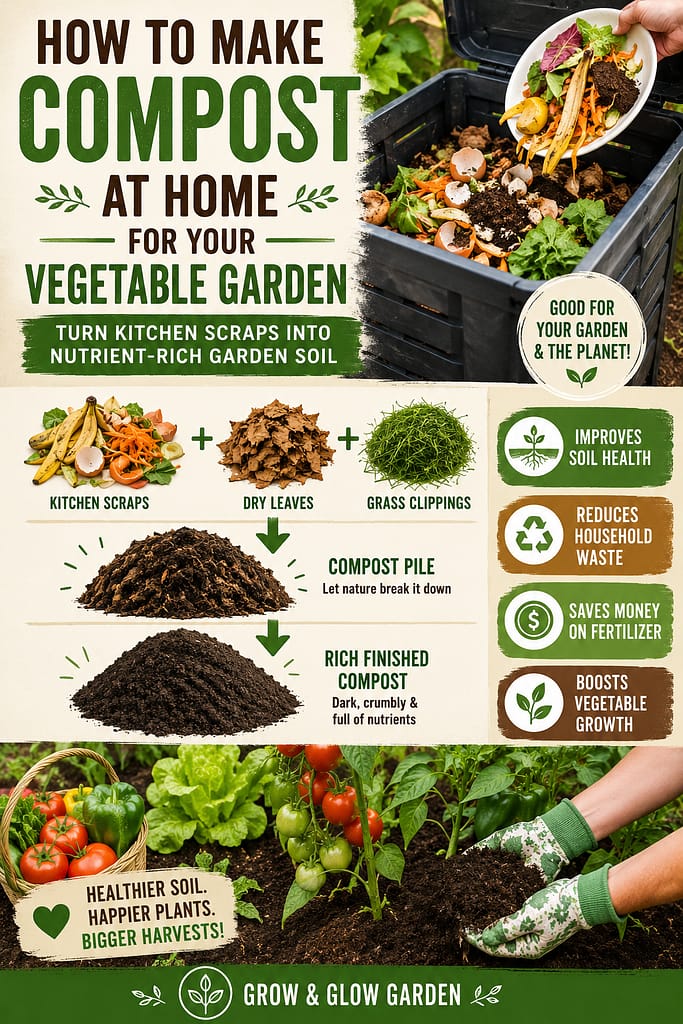
Compost is decomposed organic matter created when natural materials such as fruit peels, vegetable scraps, leaves, and grass clippings break down over time.
As these materials decompose, they form a dark, crumbly substance rich in nutrients and beneficial microorganisms that improve soil health.
Think of compost as nature’s recycling system.
Benefits of Compost for Vegetable Gardens
Adding compost to your vegetable garden offers many benefits.
Improves Soil Structure
Compost helps loosen heavy clay soils and improves water retention in sandy soils.
Provides Nutrients Naturally
Compost slowly releases nutrients that plants need for healthy growth.
Improves Water Retention
Healthy compost helps soil hold moisture longer, reducing the need for frequent watering.
Encourages Beneficial Microorganisms
Compost supports beneficial organisms that help break down organic matter and improve soil fertility.
Reduces Household Waste
Instead of throwing organic materials in the trash, you can recycle them into valuable compost.
What Can You Compost? Kitchen and Garden Materials
What to Add — Green Materials (Nitrogen Rich)
Green materials are nitrogen-rich ingredients that provide the energy and protein microorganisms need to break down your compost pile quickly. In Jamaica we have an abundance of excellent green materials available year-round:
- Vegetable and fruit scraps from your kitchen — banana peels mango skins orange peels papaya scraps callaloo trimmings etc
- Fresh grass clippings from your lawn
- Fresh green leaves and plant trimmings from your garden
- Coffee grounds and tea bags
- Breadfruit leaves and stems
- Banana leaves and stalks
- Fresh weeds that have not yet gone to seed
- Chicken or other animal manure — excellent nitrogen source
- Seaweed if you live near the coast — very nutrient rich
Pro Tip: Banana peels are one of the best composting materials available in Jamaica — they decompose quickly and add potassium which is essential for root development and fruit production in vegetable plants. Never throw a banana peel in the garbage when you have a compost pile!
What to Add — Brown Materials (Carbon Rich)
Brown materials are carbon-rich ingredients that provide the structure and energy for long-term decomposition. A good compost pile needs roughly equal amounts of green and brown materials — too many greens makes a smelly slimy pile and too many browns makes a pile that decomposes very slowly:
- Dry fallen leaves — Jamaica has an abundance of these year-round
- Dry grass clippings and straw
- Shredded cardboard and paper — remove any plastic tape or coatings
- Coconut husks and coconut shells — widely available across Jamaica
- Sugarcane bagasse and dry sugarcane stalks
- Dry corn stalks and husks
- Wood chips and small twigs — chop or break into small pieces
- Brown paper bags and newspaper — shredded into small pieces
- Dry breadfruit leaves
Pro Tip: Coconut husks are an outstanding composting material that is uniquely available to Jamaican and Caribbean gardeners. They break down slowly providing structure to your compost pile and eventually adding excellent organic matter to your finished compost. Chop them into smaller pieces to speed up decomposition.
What NEVER to Add to Your Compost
Some materials should never go into your home compost pile as they can attract pests create unpleasant odours or introduce harmful pathogens into your garden:
Never Compost: Meat fish and bones — attracts rats mongooses and other pests
Never Compost: Dairy products — milk cheese butter — attracts pests and creates bad odours
Never Compost: Cooking oils and greasy food scraps — slows decomposition and attracts pests
Never Compost: Dog or cat faeces — can contain harmful pathogens dangerous to humans
Never Compost: Diseased plants — can spread disease to your garden through finished compost
Never Compost: Weeds that have gone to seed — seeds survive composting and sprout in your garden
Never Compost: Citrus peels in large quantities — can slow decomposition and affect soil pH
Never Compost: Anything treated with pesticides or herbicides — chemicals persist in compost
How to Make Compost at Home Step by Step
Now let us get into the practical step by step process of making your own compost at home in Jamaica. We will cover the simplest method first — the open pile method — which requires no special equipment and works perfectly in Jamaica’s warm tropical climate.
Step 1 — Choose Your Composting Method
Before you start you need to decide which composting method works best for your space and situation. We will cover the main options in detail in the next section but for now here are your choices:
- Open pile composting — simplest method, no container needed, best for large yards
- Compost bin composting — contained and tidy, good for smaller spaces
- Trench composting — bury scraps directly in garden beds, extremely simple
- Worm composting (vermicomposting) — perfect for small spaces and indoor gardens
Step 2 — Choose Your Location
The location of your compost pile or bin matters more than most people realize. Choose a spot that is:
- In partial shade — full sun in Jamaica’s heat dries out your pile too quickly
- Convenient to reach from your kitchen so you add scraps regularly
- On bare soil rather than concrete — allows beneficial organisms to enter from below
- Away from your house windows and doors — a well-managed pile should not smell but it is better to keep it at a distance
- Near your vegetable garden — makes it easy to use the finished compost
Pro Tip: In Jamaica the ideal spot for a compost pile is under a large tree that provides dappled shade. The tree roots benefit from the nutrients that leach down from the pile, and the shade keeps the pile moist during dry season.
Step 3 — Build Your Compost Pile
If you want to speed up the composting process even further a compost accelerator introduces billions of beneficial microorganisms directly into your pile dramatically reducing the time it takes to produce finished compost — particularly useful during Jamaica’s cooler months when decomposition naturally slows down slightly.”
As an Amazon Associate I earn from qualifying purchases
Building a good compost pile is like making a layered cake — alternating layers of different materials creates the ideal conditions for fast decomposition. Here is how to build your pile:
- Start with a 4 to 6 inch layer of brown materials on the bottom — dry leaves twigs or straw
- Add a 2 to 3 inch layer of green materials on top — kitchen scraps fresh grass clippings or garden trimmings
- Add a thin layer of soil or finished compost — this introduces the microorganisms that do the work
- Lightly water the pile so it is moist like a wrung-out sponge — not soaking wet
- Repeat the layers — brown green soil — until your pile is at least 3 feet high
- Finish with a layer of brown materials on top to prevent odours and deter pests
Pro Tip: The ideal compost pile size for home gardens is at least 3 feet wide by 3 feet tall. Smaller piles do not generate enough heat to decompose quickly. If you cannot make it that large at once just keep adding materials over time until the pile reaches a good size.
Step 4 — Maintain Your Compost Pile
A compost pile is a living system that needs a little attention to work well. Here is how to maintain your pile for fast results:
- Turn your pile every 1 to 2 weeks using a garden fork — this adds oxygen and speeds up decomposition dramatically
- Check moisture regularly — the pile should feel like a moist sponge. If it feels dry add water. If it feels soggy add more brown materials
- Keep adding materials in balanced green and brown layers as they become available
- In Jamaica’s dry season your pile may dry out faster — check moisture more frequently and water as needed
- In the rainy season cover your pile with a tarp or old zinc to prevent it becoming waterlogged
Pro Tip: If you live in warm tropical climate is actually a huge advantage for composting! The heat accelerates decomposition significantly. While a compost pile in a cold climate might take 6 to 12 months to finish in Jamaica’s warmth climate you can have finished compost ready in as little as 6 to 8 weeks with regular turning.
A compost thermometer takes all the guesswork out of managing your compost pile — simply insert it into the center of your pile to check the internal temperature. An active hot compost pile should reach between 55 and 65 degrees Celsius which is hot enough to kill weed seeds and harmful pathogens while accelerating decomposition significantly.”
Step 5 — Know When Your Compost is Ready
Finished compost looks smells and feels completely different from the materials you put in. Here is how to tell when your compost is ready to use:
- It looks dark brown to black — similar to rich chocolate cake crumbs
- It smells earthy and pleasant — like a forest floor after rain, not like rotting food
- You cannot identify the original materials — no recognizable food scraps or leaves
- It has a crumbly texture that falls apart easily in your hands
- The pile has shrunk to roughly one third of its original size
Pro Tip: If you can still see recognizable food scraps or leaves in your compost it is not quite ready. Simply continue turning and waiting. Partially finished compost can be used as a mulch on top of soil but should not be mixed directly into the root zone of plants.
Best Composting Methods for Jamaican Home Gardeners
1. Open Pile Composting

The simplest and most traditional composting method — just pile your materials in a corner of your yard and let nature do the work. This method requires no investment costs nothing and works beautifully in Jamaica’s warm climate. The main disadvantage is that it looks untidy and may attract pests if not managed properly. Best for gardeners with larger yards in rural or semi-rural areas.
Pro Tip: Surround your open compost pile with four stakes and some wire mesh or old boards to keep it tidy and prevent materials from spreading. This costs almost nothing and makes a huge difference to the appearance of your composting area.
2. Compost Bin Composting
A contained compost bin keeps your composting area neat tidy and pest-resistant. You can buy a ready-made compost bin from Amazon or make your own from old wooden pallets wire mesh or even old drums. A bin is the ideal solution for Jamaican home gardeners with smaller yards or those who want a tidier more organised composting setup.
3. Compost Tumbler
Compost tumblers make turning compost easier and can speed up decomposition by keeping the materials aerated, pest-free, and tidy, turning kitchen scraps and yard waste into rich fertilizer in just a few weeks.
For even faster results a compost tumbler is one of the best composting investments you can make — simply add your materials close the lid and tumble it every few days. The sealed rotating design keeps pests out speeds up decomposition dramatically and in Jamaica’s warm climate can produce finished compost in as little as 4 to 6 weeks!”
As an Amazon Associate I earn from qualifying purchases
Pro Tip: always maintain the ratio 2 parts carbon (browns) to 1 part nitrogen (greens) and keep the contents moist should feel like a damp sponge – the rule is if it too dry adding water if too wet add more dry leaves. And turn the tumbler 5 to 10 times 2 or 3 times per week for best aeration.
4. Worm Composting (Vermicomposting)
Worm composting uses special composting worms — usually red wigglers — to break down kitchen scraps into incredibly rich worm castings that are among the most potent natural fertilizers available. A worm bin can be kept indoors or on a veranda making it perfect for Jamaican apartment dwellers and container gardeners with no outdoor space.
Pro Tip: Worm castings are so rich in nutrients that even a small amount added to your container plants or seedling trays makes a dramatic difference to plant health and growth. Many Jamaican gardeners who start worm composting say it is the single biggest improvement they ever made to their container garden.
Jamaican Materials That Make Excellent Compost
One of the great advantages of composting in Jamaica is the extraordinary variety of organic materials available to us year-round that gardeners in colder climates simply do not have access to. Here are some of the best Jamaica-specific composting materials:
Coconut Husks and Shells
Coconut husks are one of the most abundant agricultural byproducts in Jamaica and they make outstanding composting material. They decompose slowly providing long-lasting structure to your compost pile and eventually breaking down into a material very similar to commercially sold coconut coir. Chop or shred husks into smaller pieces to speed up decomposition.
Banana Leaves and Peels
Jamaica produces enormous quantities of bananas and the leaves peels and stalks are all excellent composting materials. Banana peels are rich in potassium and decompose quickly. Banana leaves are bulkier but provide good carbon content. Old banana plants that have finished producing can be chopped up and composted entirely.
Sugarcane Bagasse
The fibrous material left after sugarcane is processed — called bagasse — is an excellent brown composting material. It is widely available in sugarcane-growing parishes and provides excellent carbon content and structure to the compost pile. Mix it well with nitrogen-rich green materials for best results.
Breadfruit Leaves
Breadfruit trees are everywhere in Jamaica and they drop large quantities of leaves throughout the year. These leaves are excellent composting material — they are large and need to be chopped or shredded to decompose properly but once broken down they add valuable organic matter to finished compost.
Kitchen Scraps — The Jamaican Kitchen
The typical Jamaican kitchen produces a remarkable variety of excellent composting materials. Mango skins and seeds papaya scraps pineapple tops and skins callaloo stems and roots cassava and yam peelings breadfruit cores ackee pods and countless other fruit and vegetable scraps that are unique to our cuisine and culture. All of these materials decompose beautifully and return valuable nutrients to your garden soil.
Pro Tip: Keep a small bucket with a lid on your kitchen counter specifically for compost scraps. Empty it into your compost pile every day or two. This simple habit dramatically increases the amount of material going into your compost and reduces the effort of making regular trips to your pile.
“The easiest way to collect kitchen scraps consistently is to keep a small kitchen countertop compost bin right next to your sink — making it effortless to drop in banana peels vegetable trimmings and fruit scraps throughout the day rather than making repeated trips outside to your compost pile.”
As an Amazon Associate, I earn from qualifying purchases
Common Composting Mistakes and How to Avoid Them
- Adding too many green materials at once — causes a slimy smelly pile. Always balance with equal browns
- Not turning the pile regularly — slows decomposition dramatically. Turn at least every 2 weeks
- Letting the pile dry out — kills the microorganisms doing the work. Check moisture weekly
- Making the pile too small — small piles cannot generate enough heat. Aim for at least 3 feet in each direction
- Adding materials in large chunks — large pieces take much longer to break down. Chop or shred everything before adding
- Forgetting about it completely — a neglected pile still composts eventually but takes much longer. Give it regular attention
- Adding too much of one material at a time — like a full bag of grass clippings. Mix different materials for best results
Never Compost: Never add diseased plants to your compost pile — diseases and fungal spores can survive the composting process and spread to your healthy plants when you use the finished compost. Dispose of diseased plant material separately.
How to Use Your Finished Compost in Your Vegetable Garden
Finished compost can be used in several ways to improve your vegetable garden:
As a Soil Amendment
Mix 2 to 4 inches of finished compost into the top 6 to 8 inches of your garden bed soil before planting. This is the most effective way to use compost — it improves soil structure adds nutrients and feeds the beneficial microorganisms in your soil all at once.
As a Mulch
Spread a 1 to 2 inch layer of compost on top of your soil around existing plants. As it breaks down further the nutrients leach into the soil and feed plant roots. This method also suppresses weeds and helps retain moisture during Jamaica’s dry season.
As a Potting Mix Ingredient
Mix finished compost with soil and other amendments to create an excellent homemade potting mix for containers and raised beds. A good basic mix is one part compost one part garden soil and one part coconut coir or perlite for drainage.
As a Liquid Fertilizer — Compost Tea
Fill a bucket halfway with finished compost and top up with water. Let it steep for 24 to 48 hours stirring occasionally. Strain out the solids and use the liquid to water your plants directly. Compost tea is a powerful liquid fertilizer that delivers nutrients directly to plant roots and is especially beneficial for seedlings and young plants.
Pro Tip: Compost tea made from your own homemade compost is one of the most powerful free fertilizers you can give your vegetable garden. Apply it every 2 to 3 weeks during the growing season for noticeably improved plant health and productivity
Frequently Asked Questions About Composting in Jamaica
How long does composting take in Jamaica?
Jamaica’s warm tropical climate is ideal for fast composting. With regular turning and proper moisture management you can have finished compost ready in as little as 6 to 8 weeks during hot weather. Without turning a cold compost pile may take 3 to 6 months. Either way Jamaica’s warmth gives us a significant advantage over gardeners in colder climates!
Does a compost pile smell bad?
A well-managed compost pile should smell earthy and pleasant — like a forest floor. Bad smells are usually caused by too many green materials not enough turning or too much moisture. If your pile smells add more brown materials turn it thoroughly and check that drainage is good. A properly balanced pile should not create any offensive odours.
Can I compost in an apartment or on a small veranda?
Absolutely! Worm composting is perfect for apartment and veranda gardeners. A worm bin takes up very little space can be kept indoors and produces incredibly rich worm castings that your container plants will love. Many Jamaican apartment gardeners keep a small worm bin under the kitchen sink or on their veranda with excellent results.
What if I do not have enough brown materials?
In Jamaica finding brown materials is usually not difficult — dry leaves coconut husks dry grass and shredded cardboard are all widely available. If you are short on browns shred some old newspapers or cardboard boxes which are readily available from any supermarket or hardware store.
Can I use compost on all vegetables?
Yes — compost benefits all vegetable plants. It is particularly valuable for heavy feeders like tomatoes peppers corn and callaloo that need consistent nutrition throughout the growing season. Even light feeders like beans and herbs benefit from the improved soil structure that compost provides.
Recommended Books to Deepen Your Composting Knowledge
If you want to go deeper into composting beyond what we have covered here are the other three most highly recommended books available:
📚Book 2 — ‘Compost by Charles Dowding‘ — From one of the world’s most respected no-dig gardening experts covering composting for all garden size.
As an Amazon Associate, I earn from qualifying purchases
📚 Book 3 — ‘The Rodale Book of Composting‘ — The classic comprehensive reference guide that has help gardeners for decades.
📚 Book 4 — ‘The Self Sufficiency Garden by Huw Richards‘ — For gardeners who want to grow as much of their own food as possible. Includes practical composting guidance.
As an Amazon Associate, I earn from qualifying purchases
Helpful Resources
You may also enjoy:
- Why Your Vegetable Plants Are Growing Slowly
- Why Your Vegetable Plants Have Yellow Leaves
- Why Are My Vegetable Plants Wilting?
- How to Start a Backyard Vegetable Garden
- Common Gardening Mistakes and How to Avoid Them
Conclusion
Making compost at home is one of the best investments you can make in your vegetable garden. It improves soil health, provides nutrients naturally, helps retain moisture, and reduces household waste.
Whether you use a simple compost pile, a compost bin, or a compost tumbler, creating your own compost is a rewarding way to support healthier plants and bigger harvests.
Start small, stay consistent, and before long you’ll be producing your own supply of nutrient-rich compost to help your vegetable garden thrive.
Start your compost pile this week – your vegetable garden will thank you for years to come!